Can Adults Minimise Their Accents When Speaking English in 3 Months?
——My Love-Hate Relationship with English Pronunciation……
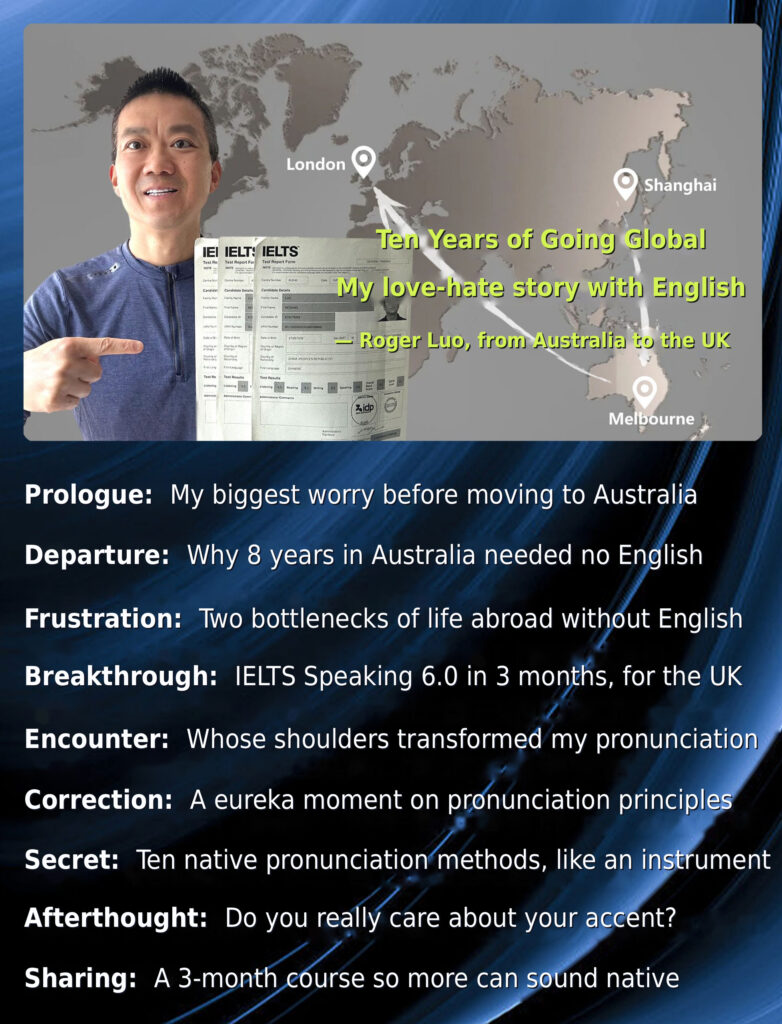
Time flies — it’s been 10 years since Roger Luo began his journey of living globally. Many people assume that, having used new media operations to obtain an Australian PR through the 188A visa, and having DIY-applied for a UK Innovator visa himself, his English speaking must be great — or at least not his weak point. Actually, my relationship with spoken English is one of love and hate — absolutely a vivid, unforgettable scene along my journey of global living. Come and check out the 9 personal-experience chapters Roger Luo has summarized, and let’s explore together: can an adult, in just 3 months, reach native-speaker-level pronunciation through intensive accent correction?
Prologue
The biggest worry before venturing into Australia
Setting Off
Why 8 years in Australia meant never really needing to learn English
Frustration
The two major bottlenecks of living abroad without English
Breakthrough
Reaching Band 6 in IELTS speaking in just 3 months, for the UK
Encounter
Whose shoulders to stand on to make your spoken pronunciation break through
Accent Correction
An enlightening, eye-opening realization about English pronunciation principles
The Secret
Learning the ten native-speaker pronunciation methods like learning a musical instrument
Lingering Notes
Do you actually care whether your English has an accent?
Sharing
A 3-month intensive accent-correction course, helping more people pronounce English like native speakers
Prologue: The Biggest Worry Before Venturing Into Australia
Ten years ago, when my wife first proposed that our family immigrate to Australia, I firmly declined. My reasoning was straightforward: at 40 years old, I had severe myopia and didn’t speak English. The thought of starting from scratch to learn English, risking further deterioration of my eyesight, was daunting. Moreover, neither my wife nor our 8-year-old son spoke English. How could we possibly survive in an English-speaking country like Australia?
Ten years ago, when my wife first proposed that our family immigrate to Australia, I firmly declined. My reasoning was straightforward: at 40 years old, I had severe myopia and didn’t speak English. The thought of starting from scratch to learn English, risking further deterioration of my eyesight, was daunting. Moreover, neither my wife nor our 8-year-old son spoke English. How could we possibly survive in an English-speaking country like Australia?
Prologue: The Biggest Worry Before Venturing Into Australia
Ten years ago, when my wife first proposed that our family immigrate to Australia, I firmly declined. My reasoning was straightforward: at 40 years old, I had severe myopia and didn’t speak English. The thought of starting from scratch to learn English, risking further deterioration of my eyesight, was daunting. Moreover, neither my wife nor our 8-year-old son spoke English. How could we possibly survive in an English-speaking country like Australia?
After scouting Australia as a travel destination, in order to get my son out of China’s education system as early as possible, I immediately applied for Australia’s 188A visa. In November 2016, our family of three — three plane tickets, three suitcases — arrived in Melbourne, a city with no family or friends. Roger Luo happily discovered that living and starting a business in Australia basically didn’t require English at all.
First, official statistics put the Chinese population share in Australia at 5.5%, concentrated mainly in Melbourne and Sydney — though in real life it feels even higher. Take Box Hill in Melbourne, for example, where the Chinese population exceeds 30%: once you’re there, you truly experience that “speak good Mandarin and you can go anywhere in Box Hill without fear.”
Second, when it came to Roger Luo’s business, there were plenty of Chinese-run enterprises in Australia. Just by targeting local Chinese people as customers, he easily hit the AUD 300,000 annual revenue requirement needed at the time to convert the 188A visa into PR.
Even for local Western businesses — say, a local law firm or a clinic offering branding, marketing, and new-media services — Roger Luo still didn’t need to spend time learning English. He simply hired an international student as a part-time translator for the company. What’s more, an increasing number of local Western businesses have started paying attention to the Chinese market and have staffed up with Chinese employees.
Setting Off: Why 8 Years in Australia Meant Never Really Needing to Learn English
Frustration: The Two Major Bottlenecks of Living Abroad Without English
Roger Luo has run a business in Australia for 8 years without speaking English. How much trouble could that really cause? Abroad, what matters most is finding your own circle — and within a few years in Melbourne, he’d built as wide a friend group as decades back home.
Still, living somewhere English is official does create two real bottlenecks: one professional, one personal.
Growing beyond the local Chinese business community into Western enterprise required at least conversational business English. Roger Luo learned this while working with the City of Casey government, organizing major China-Australia events — until a delegation visit to Shanghai, when his translator briefly stepped out. He and the lead official just stared at each other, neither able to say a word. Fluent English in that moment could have deepened the partnership significantly.
The personal bottleneck is his son. They arrived together, but Xiao Luo’s English long ago overtook his Chinese, while Roger Luo’s stayed frozen in place — still relying on his son to translate everyday things like bank accounts. It quietly nags at him: he never managed to learn alongside his son, to grow together.
For a serial entrepreneur who has ventured across the world, language was never really an insurmountable barrier. In 2022, after successfully obtaining Australian PR through new-media operations, Roger Luo wanted to give his son — already attending Scotch College, one of Australia’s top private schools — an even better education. He decided to apply for a top private school in the UK for Xiao Luo. At the same time, in order to better accompany his son’s growth in the UK, Roger Luo himself went on to venture into the UK and applied for the UK’s Innovator Founder Visa. Besides requiring an innovative business plan endorsed by an immigration-authority-designated endorsing body, the most challenging requirement for Roger Luo was the language requirement: IELTS listening, speaking, reading, and writing each needed to be no lower than 5.5 — with speaking in particular requiring at least 5.5 — which was the most challenging part for someone as “mute” in English as Roger Luo.
Breakthrough: Reaching IELTS Speaking Band 6 in Just 3 Months, for the UK
When Roger Luo applied for Australia’s 188A visa in 2015, there was actually an IELTS 4.5 language requirement too — or he could pay an extra English-training fee to have it waived. Knowing himself well, Roger Luo didn’t hesitate: he paid the several-thousand-dollar training fee. But this time, applying for the UK’s Innovator visa, there was no alternative to the IELTS 5.5 requirement. What to do?
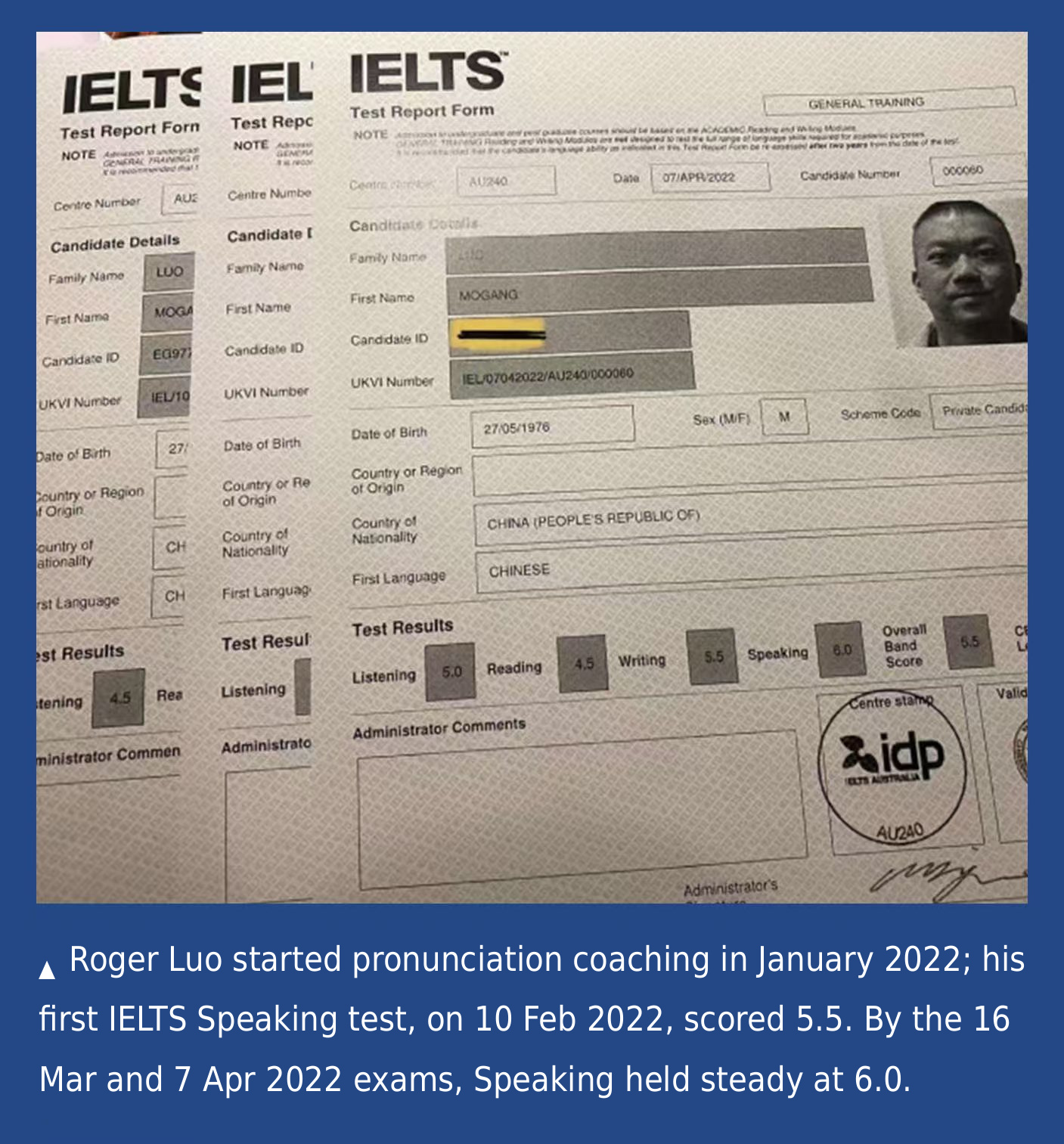
As it turned out, language was never truly an insurmountable barrier on the road of global living — Roger Luo needed less than 3 months to bring his IELTS speaking steadily up to Band 6.
The secret to this method isn't effort, and it isn't talent — it's using your own network to find an English teacher who can make your speaking, especially your pronunciation, break through in the shortest possible time
Encounter: Whose Shoulders to Stand on to Make Your Spoken Pronunciation Break Through
Even after 8 years running a business in Australia, Roger Luo had thought about improving his spoken English. Reading and writing can be handled by translation tools, but listening and speaking are about real human connection — pull out a translation app mid-conversation with a native speaker, and the distance between you instantly grows.
The trouble was, in 8 years he’d never found the right teacher. English teachers are everywhere, but having lived immersed in Australia’s spoken environment, Roger Luo could judge someone’s fluency by ear alone — and among Chinese immigrants, he’d never met one who spoke at native level and also taught English.
Persistence paid off: he found Teacher Xiaohui, a Tsinghua graduate (Economics and English), former economics lecturer at a State University of New York campus, fluent in over ten languages, and now a senior English teacher at a well-known Australian private school — with English at a genuinely native level.
Under her guidance, Roger Luo broke through fast: IELTS speaking Band 6 in 3 months. More importantly, her intensive accent training gave him a real “aha” moment on the mechanics of pronunciation — the shoulders he stood on to open the door to rapid progress.
Accent Correction: An Enlightening Realization About the Principles of English Pronunciation
Roger Luo began his global-living journey at 40, and even nearing 50 he keeps a stubborn streak — including toward English: no half-measures, learn it well or not at all.
Conventional wisdom says the best age to learn English is 3 to 7, and after 8 it’s nearly impossible to sound native. Roger Luo never accepted that. Children have a gift for imitation, but can’t explain why sounds work the way they do. Adults, especially sharp learners, can consciously compare their mother tongue against a new language and learn the logic behind it. Chinese, British, and American speakers share the same vocal anatomy — so why shouldn’t pronunciation be learned principle by principle, like an instrument?
That years-long puzzle clicked into place with Teacher Xiaohui’s accent course. Where school had only taught phonetic symbols, she taught the logic behind them: English sounds split into vowels (governed by mouth shape) and consonants (governed by place of articulation) — vowels flow uninterrupted, consonants work through different kinds of obstruction. Once he understood that, learning native pronunciation became as systematic as learning an instrument.
The Secret: Learning the Ten Native-Speaker Pronunciation Methods Like Learning a Musical Instrument
Most English teaching relies on phonetic symbols. Teacher Xiaohui’s course skips surface fixes entirely — instead, you learn native pronunciation methods like an instrument, practicing with materials tailored to your needs until native-like speech becomes muscle memory.
English pronunciation is actually simpler than Chinese in one way: spelling and sound align, unlike Chinese characters. But it demands far more coordinated use of the vocal organs — lips, teeth, palate, tongue, throat, nasal cavity, vocal cords, and diaphragm all working together, unlike Roger Luo’s mumbled Mandarin that still gets understood.
Below are the ten pronunciation details from his three months with Teacher Xiaohui that completely overturned his Roger habits. See how many “Chinglish” habits you recognize in yourself.
A decade has passed, and to my surprise, our family not only integrated swiftly into our Australian life and careers but also embarked on a new journey to the UK three years ago. Through these global transitions, I’ve gleaned two significant insights about the English language:
English, particularly spoken English, is undeniably crucial for individuals’ global development.
More pertinently, even as adults, it’s possible to minimise one’s accent through three months of intensive pronunciation training, achievinga fluency level comparable to native speakers. For instance, from being hesitant to speak at all, my IELTS speaking score improved rapidly to 6 after just three months of focused practice.
It’s commonly believed that the optimal age for language acquisition is between 3-7 years, and surpassing this window makes native-like proficiency elusive. However, my personal experience suggests that with the right methods, success is attainable. After all, the articulatory organs of Chinese speakers aren’t structurally different from those of English speakers.
Fortune smiled upon me three years ago when I met teacher Ma. Under her guidance, I began approaching English pronunciation as one would learn a musical instrument. Here are the most profound differences I have learned about speaking Chinese and English:
Insufficient Mouth Opening
Traditional Chinese culture values subtlety and reservedness and even showing teeth while smiling is discouraged. However, English pronunciation frequently requires a wide mouth opening. For example, vowels in common words like “can,” “bag,” and “gap” necessitate not only a broad mouth opening but also a downward jaw movement. Without this, names like “Allen” and “Ellen” might sound indistinguishable.
Lack of Mouth Corner Stretching
Mandarin discourages “baring teeth,” which is a crucial feature of many sounds in English. Words such as “she,” “see,” and “keep” require this to differentiate from sounds in words like “in,” “six,” and “big.” Neglecting this can lead to misunderstandings, especially with words like “beach” and “sheet,” which might be misheard as inappropriate terms.
Not Pursing Lips
In Mandarin, lip-pursing is rare. Yet, in English, words like “you” require rounded, pursed lips. Many Chinese speakers miss this nuance, making it evident to locals that they’re non-native speakers.
Not Biting the Tongue
English contains dental fricatives absent in Mandarin, necessitating a gentle tongue bite. While this isn’t challenging to learn, forming the habit is crucial. Mispronunciations can lead to confusions like hearing “sink” instead of “think” or “base” instead of “bathe.”
Not Elevating the Tongue Tip
Understanding that consonants often involve “blocking” airflow helps in realising the need to elevate the tongue tip. In phrases like “I will be back!” from “The Terminator,” the exaggerated tongue movement is standard in American pronunciation.
Tongue Not Curling to the Gum Ridge
Even in middle age, learning native-like pronunciation from scratch is doable — with the right teacher pointing out the details. Teacher Xiaohui always says: the tongue tip needs to press up. But where exactly?
Not like Chinese pinyin, where sounds like “特” or “的” just touch the upper teeth. Speaking English the “Chinese way” may still be understood, but never sounds native. Many consonants need the tongue tip pressed against the upper gum ridge, not the teeth — then released in a burst as air escapes.
Roger Luo’s hardest part was the itchy gum ridge and tired tongue, since 40+ years of Chinese never used this motion. But that discomfort was proof he was finally breaking free of old habits — and opening the door to a new language.
Not Engaging the Nasal Cavity
Mandarin seldom uses nasal resonance, but English has numerous nasal consonants requiring airflow through the nose with vocal cord vibration. Words like “meat,” “neat,” and “nice” exemplify this. If you don’t feel nasal airflow when pronouncing certain words, your pronunciation might lack authenticity.
Not Raising the Tongue Root
As my speaking skills improved, so did my listening. For words ending with nasal sounds like “long” and “wing,” it’s essential to raise the tongue root, allowing the soft palate to lower and block the oral cavity. This technique is frequently used, especially in continuous tenses.
Not Frictioning Lips and Teeth
English consonants often require creating obstructions using the lips and teeth. For instance, words like “fast” and “vast” involve gently biting the lower lip with the upper teeth, allowing airflow to create the desired sound.
Not Changing Mouth Shape
Mastering vowels hinges on mouth shape, while consonants depend on articulation points. For diphthongs, transitioning smoothly between two vowel sounds with corresponding mouth shape changes is crucial. Previously, I would often omit the second vowel in diphthongs, but native speakers treat both vowels equally, sometimes emphasising the second during emotional expressions.
A decade has passed, and to my surprise, our family not only integrated swiftly into our Australian life and careers but also embarked on a new journey to the UK three years ago. Through these global transitions, I’ve gleaned two significant insights about the English language:
English, particularly spoken English, is undeniably crucial for individuals’ global development.
More pertinently, even as adults, it’s possible to minimise one’s accent through three months of intensive pronunciation training, achievinga fluency level comparable to native speakers. For instance, from being hesitant to speak at all, my IELTS speaking score improved rapidly to 6 after just three months of focused practice.
It’s commonly believed that the optimal age for language acquisition is between 3-7 years, and surpassing this window makes native-like proficiency elusive. However, my personal experience suggests that with the right methods, success is attainable. After all, the articulatory organs of Chinese speakers aren’t structurally different from those of English speakers.
Fortune smiled upon me three years ago when I met teacher Ma. Under her guidance, I began approaching English pronunciation as one would learn a musical instrument. Here are the most profound differences I have learned about speaking Chinese and English:
Insufficient Mouth Opening
Traditional Chinese culture values subtlety and reservedness and even showing teeth while smiling is discouraged. However, English pronunciation frequently requires a wide mouth opening. For example, vowels in common words like “can,” “bag,” and “gap” necessitate not only a broad mouth opening but also a downward jaw movement. Without this, names like “Allen” and “Ellen” might sound indistinguishable
Not Biting the Tongue
English contains dental fricatives absent in Mandarin, necessitating a gentle tongue bite. While this isn’t challenging to learn, forming the habit is crucial. Mispronunciations can lead to confusions like hearing “sink” instead of “think” or “base” instead of “bathe.”
Not Engaging the Nasal Cavity
Mandarin seldom uses nasal resonance, but English has numerous nasal consonants requiring airflow through the nose with vocal cord vibration. Words like “meat,” “neat,” and “nice” exemplify this. If you don’t feel nasal airflow when pronouncing certain words, your pronunciation might lack authenticity.
Not Frictioning Lips and Teeth
English consonants often require creating obstructions using the lips and teeth. For instance, words like “fast” and “vast” involve gently biting the lower lip with the upper teeth, allowing airflow to create the desired sound.
Lack of Mouth Corner Stretching
Mandarin discourages “baring teeth,” which is a crucial feature of many sounds in English. Words such as “she,” “see,” and “keep” require this to differentiate from sounds in words like “in,” “six,” and “big.” Neglecting this can lead to misunderstandings, especially with words like “beach” and “sheet,” which might be misheard as inappropriate terms.
Not Elevating the Tongue Tip
Understanding that consonants often involve “blocking” airflow helps in realising the need to elevate the tongue tip. In phrases like “I will be back!” from “The Terminator,” the exaggerated tongue movement is standard in American pronunciation.
Not Raising the Tongue Root
As my speaking skills improved, so did my listening. For words ending with nasal sounds like “long” and “wing,” it’s essential to raise the tongue root, allowing the soft palate to lower and block the oral cavity. This technique is frequently used, especially in continuous tenses.
Not Pursing Lips
In Mandarin, lip-pursing is rare. Yet, in English, words like “you” require rounded, pursed lips. Many Chinese speakers miss this nuance, making it evident to locals that they’re non-native speakers.
Not Curling the Tongue Up to the Gum Ridge
Even in middle age, learning native-like pronunciation from scratch is doable — with the right teacher pointing out the details. Teacher Xiaohui always says: the tongue tip needs to press up. But where exactly?
Not like Chinese pinyin, where sounds like “特” or “的” just touch the upper teeth. Speaking English the “Chinese way” may still be understood, but never sounds native. Many consonants need the tongue tip pressed against the upper gum ridge, not the teeth — then released in a burst as air escapes.
Roger Luo’s hardest part was the itchy gum ridge and tired tongue, since 40+ years of Chinese never used this motion. But that discomfort was proof he was finally breaking free of old habits — and opening the door to a new language.
Not Changing Mouth Shape
Mastering vowels hinges on mouth shape, while consonants depend on articulation points. For diphthongs, transitioning smoothly between two vowel sounds with corresponding mouth shape changes is crucial. Previously, I would often omit the second vowel in diphthongs, but native speakers treat both vowels equally, sometimes emphasising the second during emotional expressions.
Do these ten insights challenge your previous pronunciation methods? How many similar mistakes have you encountered in your “Chinglish” pronunciation? Today, I’ve shared my experiences in English pronunciation correction. These insights will be compiled into 12 instructional videos as the inaugural training course for the SMArt Gen Learning Hub. Stay tuned!
Lingering Notes: Do You Actually Care Whether Your English Has an Accent?
If you’ve read this far, you probably carry the same soul-searching question: does it actually matter if your English has an accent?
Friends often tell Roger Luo that accent doesn’t really matter, as long as it doesn’t hinder understanding and communication works. He gets it — in this globalized age, the world has grown more diverse, and people have gotten used to all kinds of accents. Beyond our own “Chinglish,” Indian accents have long become a fixture too — call a customer service line at many Commonwealth-country companies, and it’s often thick with an Indian accent.
Roger Luo does care about accent — he’s never gotten used to Indian accents, yet Westerners understand them more easily than his own. Teacher Xiaohui, fluent in ten-plus languages, explained why using the underlying logic of vowels and consonants, and it instantly clicked (though I’ll spare her IP here!).
No double standard, though — he cares just as much about his own accent. So it’s either no English at all, translator on hand, or three months starting from zero to sound native the moment he opens his mouth.
If you share Roger Luo's mindset, come check out the "English Speaking Accent-Correction Bootcamp" — co-developed with Teacher Xiaohui since early 2022, repeatedly refined, and now a favorite among Australian entrepreneurs, with Roger Luo himself as class rep.
If you share Roger Luo's mindset, come check out the "English Speaking Accent-Correction Bootcamp" — co-developed with Teacher Xiaohui since early 2022, repeatedly refined, and now a favorite among Australian entrepreneurs, with Roger Luo himself as class rep.
Sharing: A 3-Month Intensive Accent-Correction Course, Helping More People Speak Like Native English Speakers
To hit IELTS 5.5 fast for his UK Innovator visa, Roger Luo tapped every connection he had in early 2022 and found Teacher Xiaohui. Three months of part-time training later, he’d gone from zero to well above Band 6.
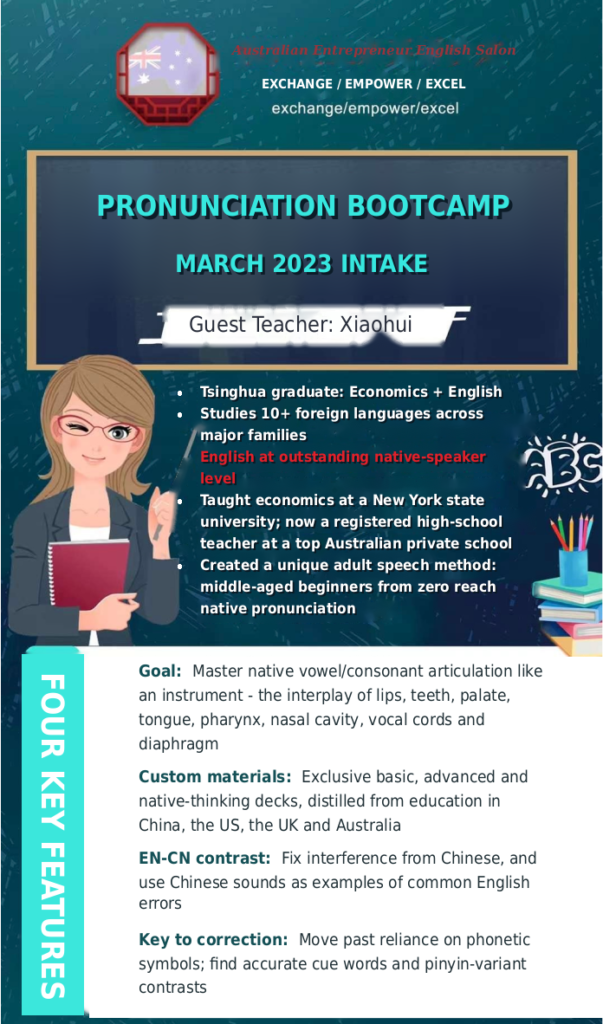
Wanting fellow Australian entrepreneurs to get the same coaching, he and Teacher Xiaohui launched the “Australian Entrepreneurs’ English Salon & Accent-Correction Bootcamp.” Refined through monthly sessions from March 2022 to March 2023, it’s helped more overseas Chinese speak fluent, native-like English.
To ensure every student gets thorough one-on-one accent correction and repeated practice guidance from Teacher Xiaohui, the bootcamp runs in small online classes of 6. Its four key features help even complete beginners achieve native-like pronunciation in the shortest possible time.
Feature 1: Learning Goal
By understanding the principles and underlying logic of English pronunciation, students learn native speakers’ pronunciation methods the way one would learn a musical instrument.
For example, the things Chinese speakers most need to work on: opening the mouth wide, opening the corners of the mouth, rounding the lips, biting down with the tongue, lifting the tongue tip, curling it to the gum ridge, opening the nasal passage, raising the tongue root, brushing the teeth with the lips, and changing mouth shape. By learning to imitate this coordinated “dance” of speech organs that native speakers use, native-like pronunciation follows naturally.
Feature 2: Customized Materials
The bootcamp’s custom materials are built on Teacher Xiaohui’s original curriculum, continuously refined based on feedback and user experience from Roger Luo and other students.
The Foundation class focuses on correcting vowels and consonants — covering their articulation features, key reference words, sound comparisons, pronunciation in sentences, and extended practice — to quickly build the most basic native pronunciation methods. The Advanced class focuses on native speakers’ rhythm patterns and techniques, such as linking, plosives, and sound shifts. The Native Mindset class uses Teacher Xiaohui’s unique “three-pronged grammar” framework as its underlying logic, helping students naturally express themselves in English the way native speakers think.
Feature 3: English-Chinese Comparison
Although adults can no longer pick up native pronunciation intuitively the way children do, they can absolutely use English-Chinese comparison to speed up understanding.
To be clear, this doesn’t mean learning English through pinyin annotations — the two are completely different language families. Rather, Teacher Xiaohui uses Chinese pronunciation as a kind of “error template” for English: the moment your English sound starts resembling a Chinese sound, you know it’s wrong.
Take the vowel in “she” and “six”: if it starts sounding like the Chinese “衣” (yī), it’s completely off. “She” needs the mouth opened wide, with articulation toward the front of the mouth — a front vowel. “衣,” on the other hand, is articulated in the middle of the mouth. And the vowel in “six” isn’t just a shortened version of the vowel in “she” — it’s more like the short, clipped “yī” in a military drill count of “one-two-one.”
Feature 4: The Key to Accent Correction
Having served as class rep for over ten cohorts, Roger Luo — the program’s biggest beneficiary — found the real key is moving past phonetic symbols and instead finding your own “correction keywords,” compared directly against pinyin.
Also, drilling vocabulary before nailing pronunciation is pointless — a train on the wrong track only drifts further away, and you’ll just need to fix those words later anyway. That’s why the full three-month program (Foundation, Advanced, Native Mindset) sticks to just 300–500 of the most common spoken words, with each student finding their own keywords.
For example, if a student nails one word’s vowel, that word becomes their “anchor” — other words with the same vowel can model on it. If a consonant shows clear pinyin interference, that word becomes a “warning” — any similarly flawed word with that consonant proves the sound still needs work.
Feature 1: Learning Goal
By understanding the principles and underlying logic of English pronunciation, students learn native speakers’ pronunciation methods the way one would learn a musical instrument.
For example, the things Chinese speakers most need to work on: opening the mouth wide, opening the corners of the mouth, rounding the lips, biting down with the tongue, lifting the tongue tip, curling it to the gum ridge, opening the nasal passage, raising the tongue root, brushing the teeth with the lips, and changing mouth shape. By learning to imitate this coordinated “dance” of speech organs that native speakers use, native-like pronunciation follows naturally.
Feature 2: Customized Materials
The bootcamp’s custom materials are built on Teacher Xiaohui’s original curriculum, continuously refined based on feedback and user experience from Roger Luo and other students.
The Foundation class focuses on correcting vowels and consonants — covering their articulation features, key reference words, sound comparisons, pronunciation in sentences, and extended practice — to quickly build the most basic native pronunciation methods. The Advanced class focuses on native speakers’ rhythm patterns and techniques, such as linking, plosives, and sound shifts. The Native Mindset class uses Teacher Xiaohui’s unique “three-pronged grammar” framework as its underlying logic, helping students naturally express themselves in English the way native speakers think.
English-Chinese Comparison
Although adults can no longer pick up native pronunciation intuitively the way children do, they can absolutely use English-Chinese comparison to speed up understanding.
To be clear, this doesn’t mean learning English through pinyin annotations — the two are completely different language families. Rather, Teacher Xiaohui uses Chinese pronunciation as a kind of “error template” for English: the moment your English sound starts resembling a Chinese sound, you know it’s wrong.
Take the vowel in “she” and “six”: if it starts sounding like the Chinese “衣” (yī), it’s completely off. “She” needs the mouth opened wide, with articulation toward the front of the mouth — a front vowel. “衣,” on the other hand, is articulated in the middle of the mouth. And the vowel in “six” isn’t just a shortened version of the vowel in “she” — it’s more like the short, clipped “yī” in a military drill count of “one-two-one.”
Feature 4: The Key to Accent Correction
Having served as class rep for over ten cohorts, Roger Luo — the program’s biggest beneficiary — found the real key is moving past phonetic symbols and instead finding your own “correction keywords,” compared directly against pinyin.
Also, drilling vocabulary before nailing pronunciation is pointless — a train on the wrong track only drifts further away, and you’ll just need to fix those words later anyway. That’s why the full three-month program (Foundation, Advanced, Native Mindset) sticks to just 300–500 of the most common spoken words, with each student finding their own keywords.
For example, if a student nails one word’s vowel, that word becomes their “anchor” — other words with the same vowel can model on it. If a consonant shows clear pinyin interference, that word becomes a “warning” — any similarly flawed word with that consonant proves the sound still needs work.
Let me quickly answer the question everyone's been eager to ask: how long does the accent-correction class typically take to sound just like a native speaker?
Using Roger Luo and past graduates as examples: for students with some basic English foundation, three classes a week plus 1–2 hours daily of practice with Teacher Xiaohui’s customized audio materials is usually enough to completely transform pronunciation and get remarkably close to native level within three months.
Of course, if you also want to level up your vocabulary within those same three months, that requires extra study effort tailored to your individual situation.
Lastly, a key perk worth flagging for everyone: the reason Roger Luo made the “English Speaking Accent-Correction Bootcamp” the flagship first course in SMArt Gen’s Cognitive Skills Navigator lineup is that he wants more overseas Chinese — especially parents accompanying children to school in the UK — to also, through three months of practice, confidently speak fluent English that reaches or comes close to native level, just as he did.
The specific course is launching soon. Anyone wanting more details can book a consultation with Roger Luo in advance.